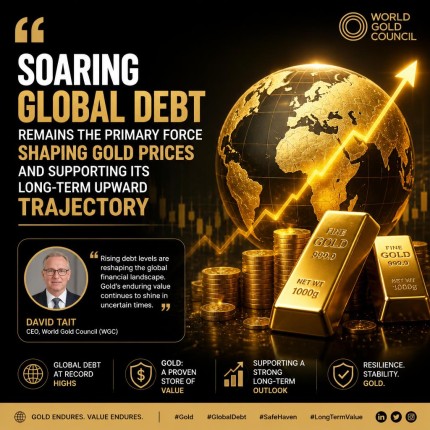
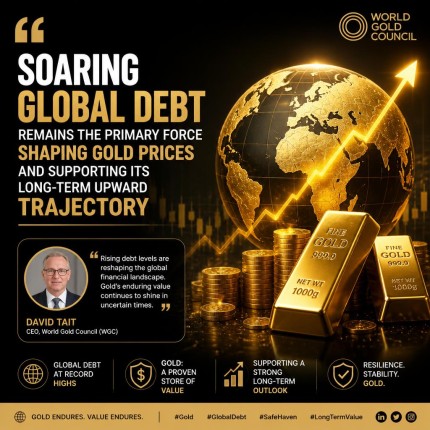
Gold continues to draw attention from investors and market observers alike, and not without reason. In a world where macroeconomic uncertainty keeps resurfacing, the metal’s long-term role as a store of value remains closely tied to one dominant theme: global debt levels. As highlighted by David Tait, CEO of the World Gold Council (WGC), soaring debt is still one of the primary forces influencing gold prices—and it’s also a major factor supporting gold’s upward trajectory over time.
While day-to-day price movements can be driven by a range of short-term variables—such as interest rate expectations, inflation prints, currency trends, and risk sentiment—the bigger picture often tells a more important story. Debt dynamics shape the policy environment, the purchasing power of currencies, and ultimately the appeal of non-sovereign assets like gold.
Why Global Debt Matters for Gold
When debt levels rise across countries, it can create a chain reaction throughout the financial system. Governments and institutions typically respond with borrowing, refinancing, and, in many cases, policy measures designed to keep markets functioning. Over time, these pressures can affect inflation expectations, real yields, and overall confidence in the stability of fiat currencies.
Gold has historically benefited during periods when investors question the long-term purchasing power of money. If debt grows faster than economic output, markets may begin to price in the risk that future repayment becomes more challenging—especially when interest costs rise or when growth slows.
This is where gold’s role as a hedge becomes particularly relevant. Unlike most financial assets, gold is not a claim on a debtor’s balance sheet. It doesn’t promise coupon payments or earnings; instead, it functions as a widely recognized reserve asset. In times when debt sustainability is questioned, that distinction can matter to capital allocation decisions.
Debt, Interest Rates, and the Real Yield Connection
One of the key channels through which debt influences gold is the interest-rate landscape. High and rising debt levels often interact with central bank policy, which in turn affects interest rates and bond yields. Gold is sensitive to the real yield environment—meaning yields after inflation—because gold doesn’t generate interest or dividends.
When markets expect that debt pressures will lead to higher inflation (or to policy approaches that tolerate inflation) the real yield outlook may shift. Even if nominal yields remain elevated, inflation expectations can reduce the attractiveness of holding cash or fixed-income instruments relative to gold.
Conversely, if rising debt results in economic fragility, investors may anticipate eventual easing by central banks, which can lower real yields and support gold prices. In both scenarios, the debt story can flow into gold through the real yield mechanism.
That’s why WGC’s perspective—framing global debt as a central force—aligns with the way gold tends to respond when investors reprice macro risk.
Long-Term Upward Trajectory: Not Just a Short-Term Trade
It’s common for investors to focus on near-term triggers for price changes. However, gold’s broader upward trajectory is often rooted in structural drivers, not just monthly data. According to David Tait’s view, soaring global debt levels remain central to the macro backdrop that underpins gold demand and price support over the long run.
Structural factors matter because they influence how investors think about the next 3–10 years, not only the next quarter. If debt accumulation persists, the probability that policymakers will rely on a combination of growth, taxation, financial repression, and/or inflation-supporting measures can rise. Even when immediate outcomes are unclear, the uncertainty itself can encourage portfolio diversification into assets like gold.
In other words, gold often benefits not only from a specific economic outcome, but from the risk that multiple outcomes are possible—especially when debt sustainability becomes a broader concern.
How Debt Can Reinforce Gold Demand
Gold demand does not come from one place. It can be influenced by central banks, institutional investors, hedging behavior, and retail interest. In debt-stressed environments, multiple demand channels can reinforce one another.
- Central bank diversification: Central banks may seek to reduce reliance on specific funding currencies or assets, especially when global financial conditions become less predictable.
- Hedge demand: Investors often look for hedges against currency debasement and inflation risk when debt levels rise and policy credibility is debated.
- Portfolio rebalancing: When uncertainty increases, investors may shift portions of portfolios toward assets perceived as resilient during periods of fiscal or monetary stress.
- Real-asset appeal: Gold’s long-standing status as a real asset can become more attractive when the macro environment looks unstable.
While each channel has its own drivers, the common thread is that debt and the policy responses to debt can increase the perceived value of gold as a stabilizing asset.
Short-Term Price Moves vs. Long-Term Drivers
To understand gold properly, it’s helpful to separate short-term volatility from long-term valuation frameworks. In the short run, gold can react to changes in:
- Inflation expectations
- Real interest rate trends
- US dollar strength and liquidity conditions
- Risk sentiment across global markets
- ETF flows and investor positioning
But over longer horizons, gold tends to track the macro narrative that shapes investor behavior. If the narrative is dominated by rising debt, financial repression concerns, or the risk that inflation could return as policymakers manage debt burdens, gold’s upward pressure can strengthen over time.
This is why the WGC framing matters: it suggests that even when markets swing in response to catalysts, the longer-term forces supporting gold remain in place.
What David Tait’s Perspective Means for Investors
David Tait, CEO of the World Gold Council, emphasizes the role of global debt levels as a key underpinning of gold’s price outlook. For investors, this implies that gold should not be evaluated only as a tactical commodity, but also as a macro hedge tied to fiscal and monetary conditions.
Investors may therefore consider gold in the context of:
- Debt sustainability trends across major economies
- Potential shifts in monetary policy in response to fiscal constraints
- Inflation and real-yield expectations over the medium to long term
- Portfolio resilience during periods of heightened uncertainty
Importantly, gold can still be volatile. But volatility doesn’t negate a long-term thesis—especially when the thesis is based on the structural reality of debt and the policy choices that often accompany it.
Debate, Uncertainty, and the Value of Alternative Assets
Global debt levels can produce disagreement about what comes next. Some scenarios suggest growth can stabilize debt ratios; others warn of weaker demand, higher financing costs, or policy trade-offs that could be inflationary. That range of possibilities is exactly what can make gold attractive.
Gold is often viewed as an alternative when consensus is fragile. In environments where investors feel that “known risks” are expanding and “unknown risks” are growing, gold’s role as a widely accepted reserve asset can become more valuable.
As uncertainty rises, the market’s willingness to pay for diversification tends to increase. That effect may show up gradually, but it can accumulate over time.
Looking Ahead: Why the Debt Story Will Likely Stay Relevant
Even if there are periods when debt concerns temporarily fade from headlines, the underlying reality of debt accumulation tends to persist. That persistence supports the idea that the macro forces influencing gold are not only cyclical—they can be enduring.
As governments and financial systems continue to navigate the intersection of growth, interest costs, and fiscal priorities, the question of how debt is managed becomes central to the global economic outlook. Gold, as the market’s long-recognized counterbalance to currency and policy risk, may continue to benefit from that long-term uncertainty.
In summary, the WGC view shared by David Tait underscores a key investment lens: soaring global debt levels are a primary force shaping gold prices and supporting its long-term upward trajectory. For readers seeking to understand gold beyond daily headlines, focusing on debt dynamics and their impact on interest rates, inflation expectations, and investor confidence can provide a clearer, more durable framework.
If you’d like, I can also tailor this article to your brand voice and add a section explaining how investors can access gold (coins, bars, and bullion options) based on different time horizons and risk profiles.