Is Gold Beginning to Look Beyond Inflation?
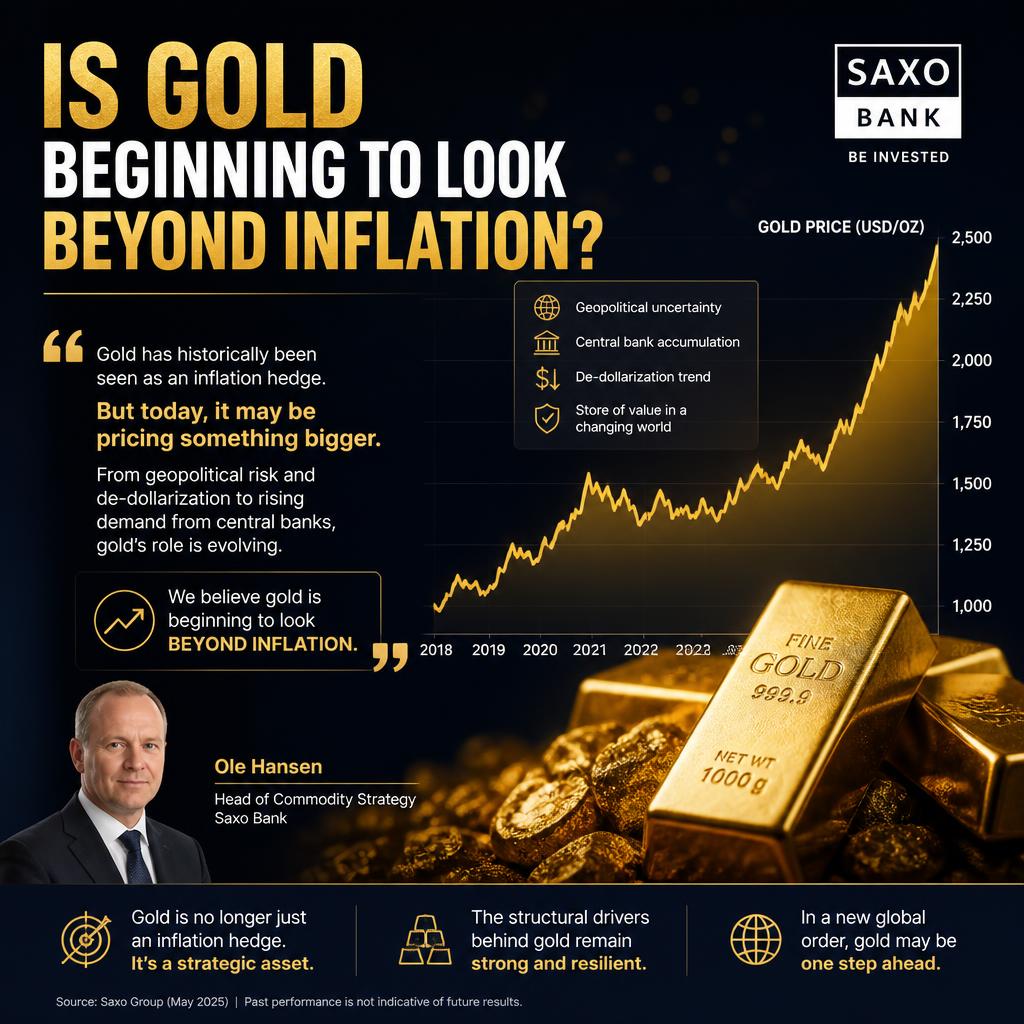
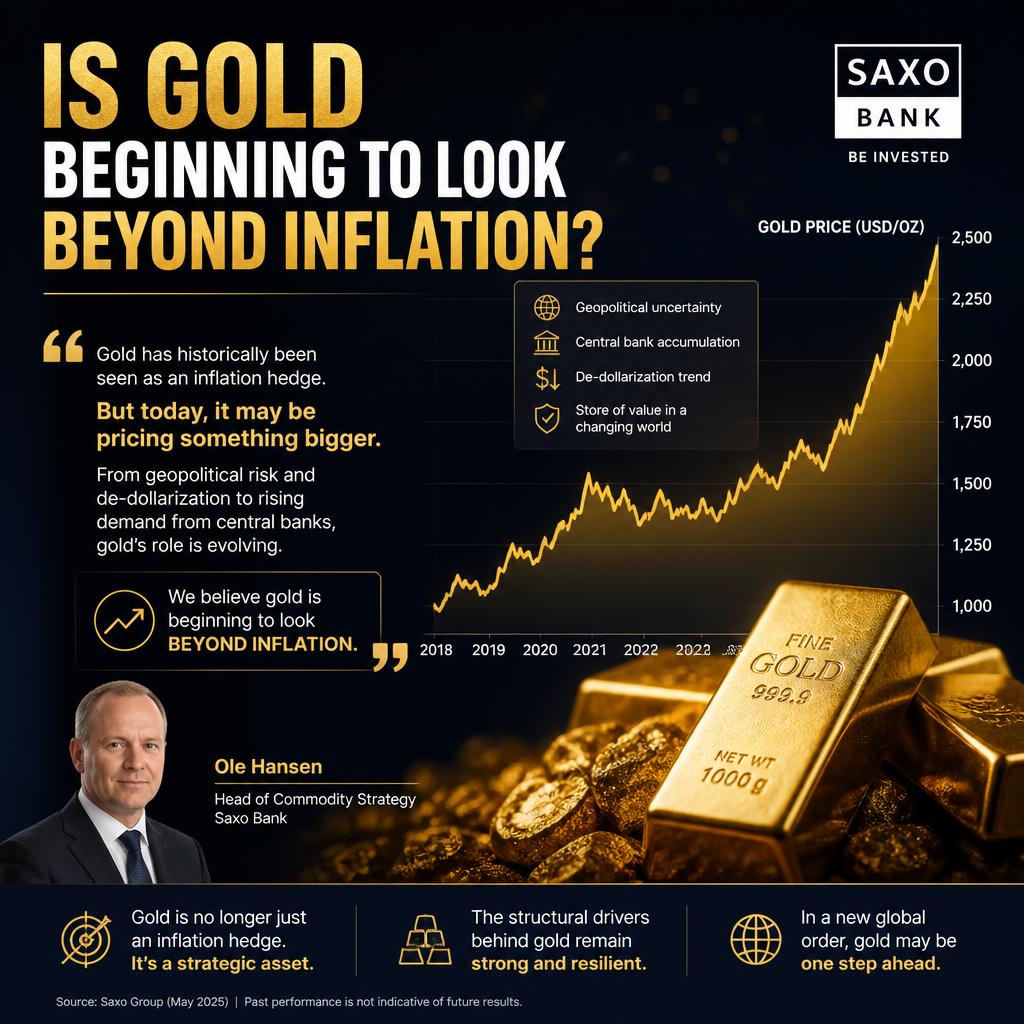
Gold has spent much of the past few years earning its reputation as an inflation hedge and a go-to safe haven during periods of economic uncertainty. When prices rise and confidence wobbles, investors often look to gold as a store of value—particularly when real purchasing power feels under threat. But the market conversation is changing. Increasingly, traders and analysts are asking a more nuanced question: Is gold beginning to look beyond inflation?
In a recent market framing from Saxo Bank’s Head of Commodity Strategy, Ole Hansen, the focus shifts from inflation alone toward a broader set of drivers—particularly the intersection of interest rates, currency dynamics, growth expectations, and shifting investor risk appetite. Understanding this evolution matters for anyone who is tracking gold prices, considering new entries, or building a long-term allocation strategy.
Why Inflation Used to Be the Dominant Gold Narrative
Historically, gold has often benefited when investors feel that paper currencies may lose purchasing power. Inflation fears—whether driven by supply constraints, energy shocks, or loose monetary conditions—tend to strengthen the case for holding a non-yielding asset like gold. The logic is straightforward: if inflation rises and interest rates don’t rise enough to compensate, the “real” return on cash and bonds can deteriorate, and gold becomes more attractive.
When inflation is the headline story, markets frequently respond by searching for assets perceived to preserve value. Gold fits that role, particularly during uncertainty. As a result, during inflationary episodes, gold can be pushed higher by a mixture of hedging demand and safe-haven flows.
What Happens When Inflation Isn’t the Only Story?
As inflation moderates—or as expectations about future inflation change—the market’s attention can move toward other variables that influence gold. Even if inflation remains a long-term concern, short-term price action often becomes increasingly sensitive to:
- Real interest rates (the yield investors earn after accounting for inflation expectations)
- Central bank policy expectations and the pace of rate changes
- US dollar strength (since gold is commonly priced in USD)
- Economic growth expectations (risk sentiment can affect safe-haven demand)
- Geopolitical and financial stability risks
This is the key shift behind the “beyond inflation” framing. If inflation is no longer the central variable—or if investors believe inflation is manageable—gold’s market drivers may increasingly reflect how policy and macro conditions evolve, rather than simply how high inflation is today.
Ole Hansen’s Commodity Strategy Perspective: A Market That’s Repricing
When analysts like Ole Hansen suggest that gold may be looking beyond inflation, the underlying idea is that the market is recalibrating. Repricing can occur when:
- Inflation data starts to be less surprising relative to expectations
- Investors anticipate a different path for policy rates
- Bond yields change in ways that alter the opportunity cost of holding gold
- Risk appetite fluctuates, influencing demand for safe havens
In practical terms, the gold market often reacts to the balance between “distrust in currencies” (which supports gold) and “cost of capital” (which depends on interest rates and bond yields). If interest rates rise in real terms, gold can face headwinds even if inflation remains a concern. Conversely, if real yields fall or policy tightness eases, gold can gain support.
Gold and Real Yields: The Opportunity-Cost Factor
Because gold does not pay interest, one of the most influential variables for its price is the opportunity cost of holding it. When investors can earn attractive real yields on bonds, gold competes less effectively. But when real yields decline—whether due to expectations for rate cuts or easing inflation pressures—the relative appeal of gold can improve.
That’s why the “beyond inflation” question is so relevant. Inflation matters, but markets often care more about whether inflation and rates move together in a way that changes real yields. If investors begin to believe that the fight against inflation is progressing and future rate hikes (or high rates) are less likely, real yields may ease—providing a supportive backdrop for gold.
The Role of Central Bank Expectations
Gold tends to respond not just to inflation prints, but to the broader implications for central bank policy. Rate expectations can change rapidly based on economic data, labor-market signals, credit conditions, and overall financial stability.
If investors come to expect:
- Fewer rate hikes than previously anticipated, or
- More rate cuts sooner than expected, or
- Greater uncertainty about growth and risk
…then gold can attract renewed interest as the market recalculates the likely path of monetary conditions.
In other words, gold doesn’t just trade inflation—it trades expectations. And those expectations include the “reaction function” of central banks.
USD Strength and Currency Dynamics
Because gold is priced in US dollars, the strength of the USD can significantly influence gold’s performance. When the dollar strengthens, gold can become more expensive for holders of other currencies, which may reduce demand. When the dollar weakens, gold can become more accessible and potentially more attractive.
Therefore, “beyond inflation” can also mean that gold is increasingly responding to:
- Relative interest rates between the US and other countries
- Changes in global risk sentiment
- Capital flows into and out of USD assets
This is another reason the market can shift away from a purely inflation-driven narrative. Gold can rally or stagnate based on currency and policy dynamics even when inflation news isn’t the main focus.
Risk Sentiment: Safe Haven Demand vs. Risk-On Markets
Gold is often described as a safe haven, but safe haven demand doesn’t operate in isolation. There are periods when risk-on markets—where investors are willing to take on more risk—reduce the urgency to buy gold. In contrast, during risk-off moments—such as banking stress, geopolitical escalations, or credible threats to financial stability—gold can benefit.
When the conversation becomes “beyond inflation,” analysts are effectively acknowledging that gold’s hedging function can broaden. Inflation concerns may have been one of the triggers for increased gold buying, but other fears—whether about liquidity, solvency, or geopolitical instability—can become equally or more important.
Supply, Investment Demand, and Market Positioning
While macroeconomic variables tend to get most of the attention, gold’s price also reflects real-world supply and demand. Investment demand can change depending on investor sentiment and portfolio positioning, while physical demand can vary by region and season.
It’s also important to remember that markets often respond to positioning—whether investors are crowded into trades or under-allocated to gold. If the market believes gold is now reacting to different drivers than before, flows can shift quickly, amplifying price movements.
In a scenario where inflation is no longer the dominant theme, traders may instead align gold with:
- Expectations for rates and bond yields
- Hedging against broader economic uncertainty
- Portfolio diversification strategies
- Response to geopolitical risk
What Could Support Gold if It’s Looking Beyond Inflation?
If gold is indeed beginning to “look beyond inflation,” then several supportive conditions could emerge:
- Declining real yields as inflation expectations cool and policy becomes less restrictive
- A weaker US dollar due to shifting rate differentials
- Persistent economic uncertainty even without runaway inflation
- Geopolitical risks that keep safe-haven demand active
- Demand for diversification as investors reassess portfolio risk
None of these factors require inflation to be surging. That’s the essence of the “beyond inflation” thesis: gold may still find buyers even when inflation isn’t the immediate headline concern.
What Could Weigh on Gold?
Just as there are supportive conditions, there are also headwinds that can pressure gold if the inflation narrative fades:
- Rising real yields driven by higher-for-longer expectations
- A strengthening US dollar that tightens financial conditions globally
- Improving risk sentiment that reduces urgency for safe havens
- Confidence in disinflation that lowers the need for hedging
As the market broadens its focus, gold can become more sensitive to shifting rate expectations than to inflation alone. That doesn’t mean inflation is irrelevant—it means the market may be less one-dimensional than before.
How Investors Can Approach Gold in a “Beyond Inflation” World
For investors and readers considering gold, a “beyond inflation” perspective encourages a broader evaluation. Instead of asking only whether inflation is high, it can be more useful to monitor:
- Trends in real interest rates
- Central bank signals and rate-path expectations
- USD strength/weakness
- Economic growth and labor-market resilience
- Geopolitical developments that elevate uncertainty
Gold can play different roles depending on the macro environment. Some buyers focus on inflation hedging, while others treat gold as insurance against a wider set of risks to purchasing power and financial stability. In a market where inflation is no longer the only driver, gold may continue to attract buyers for those broader reasons.
Why This Matters for Physical Gold and Bullion Buyers
If you’re thinking about gold as bullion—whether for long-term wealth preservation, portfolio diversification, or hedging against uncertainty—it helps to understand that gold demand is not purely tied to inflation prints. Bullion buyers may be influenced by how investors interpret the policy and economic outlook.
When the market shifts to “beyond inflation,” it can still support a constructive gold investment case, especially if real yields trend lower or uncertainty remains elevated. That said, price movements can still be volatile as expectations change.
The Bottom Line
Gold has long been associated with inflation protection, but the story may be evolving. The idea highlighted by Saxo Bank’s Ole Hansen—that gold is beginning to look beyond inflation—reflects how the market can reprice based on real yields, central bank expectations, USD dynamics, and broader risk conditions.
In short, gold may still benefit from macro uncertainty, but it may be responding to a wider set of signals than inflation alone. For investors, the most useful approach is to watch the full macro picture—especially rates, real yields, and currency trends—so you can better understand what may be driving gold’s next move.